Pre-roll dose consistency is a persistent challenge in smoked cannabis formats. Even when flower quality is high and labeling appears precise, users often report noticeable differences between sessions that are difficult to explain. One pre-roll may feel balanced and predictable, while another—seemingly identical—feels stronger, shorter, or harsher. These discrepancies are not merely subjective. They arise from a combination of combustion dynamics, inhalation behavior, and biological variability.

Multi-pack pre-roll formats offer a practical framework for reducing uncertainty by improving session-to-session comparability. Rather than eliminating variability entirely, they make it easier to identify patterns and separate product-driven factors from user-driven ones.
Why Dose Consistency Is Difficult With Pre-Rolls
Unlike measured-dose formats, pre-rolls deliver cannabinoids through combustion, a process that introduces inherent variability. Temperature fluctuates continuously along the burning cone, and cannabinoids and terpenes volatilize, degrade, or combust at different rates. As a result, the amount of THC delivered per puff is not uniform across the session.
In addition, inhalation behavior—puff duration, depth, and interval—strongly influences delivered dose. Two sessions using the same pre-roll weight can still result in different systemic exposure if puff cadence differs. These variables make it difficult to interpret a single session as representative of a product’s “true” effect profile.
Educational content across The Dispensaries of NJ highlights that consistency in inhaled formats is influenced as much by use patterns as by product formulation.
How Multi-Pack Formats Improve Session Comparability
Multi-pack pre-rolls do not make cannabis effects identical across sessions, but they provide repetition under similar conditions. When unit size, flower source, and rolling specifications are standardized, repeated sessions allow users to observe trends rather than relying on isolated experiences.
This repetition is critical for interpretation. If multiple sessions from the same pack produce similar outcomes, variability is more likely driven by context or tolerance rather than product inconsistency. If outcomes vary widely across sessions, the user can more accurately identify which variables—time of day, inhalation pattern, or environment—are influencing the experience.
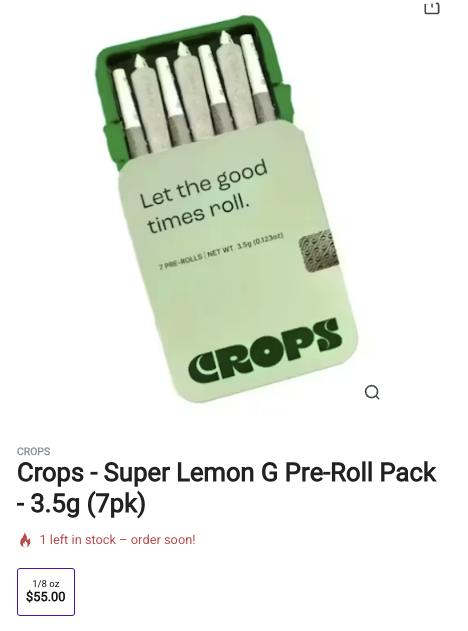
Products like the Crops Super Lemon G Pre-Roll Pack (3.5g, 7pk) illustrate how standardized multi-unit formats support this kind of comparison without introducing commercial framing.
Combustion Dynamics and Delivered Dose
Combustion is a dynamic process rather than a fixed one. As a pre-roll burns, temperature gradients form along the cone, affecting how cannabinoids and terpenes are released. Some compounds volatilize at lower temperatures, while others require higher heat and may partially degrade.
Research indexed in NIH’s NCBI documents that combustion temperature and airflow significantly influence cannabinoid yield in smoke. This means that burn rate—affected by grind size, moisture content, and paper density—directly impacts dose consistency.
Multi-pack formats help control for these variables by using the same flower batch and rolling specifications across units, reducing differences caused by material variability.
Inhalation Behavior as a Dose Variable
Pre-roll dose consistency cannot be discussed without addressing inhalation behavior. Puff topography—the pattern of puff duration, depth, and interval—determines how much smoke enters the lungs and how rapidly THC is absorbed.
Longer puffs with short intervals increase exposure over a brief period, often intensifying perceived effects. Shorter puffs with longer spacing result in a slower rise and lower peak. Because pre-rolls do not regulate airflow or dosage, these behaviors significantly affect session outcomes.
Repeated use of standardized pre-rolls allows individuals to recognize how their own inhalation patterns influence effects, making dose-response relationships clearer over time.
Biological Variability Still Matters
Even with consistent product units, biological factors such as metabolism and tolerance continue to shape outcomes. THC is metabolized at different rates depending on enzyme expression, body composition, and frequency of use. Over time, tolerance alters CB1 receptor responsiveness, changing how the same delivered dose is experienced.
However, multi-pack formats help isolate these biological variables by holding the product constant. When variability persists across identical units, it becomes easier to attribute changes to physiological adaptation rather than product inconsistency.
Educational summaries on tolerance and cannabinoid metabolism, including those curated by Project CBD, emphasize that variability is an expected outcome of human biology rather than a failure of cannabis products.
Session Comparability vs Session Uniformity
It is important to distinguish between comparability and uniformity. Pre-roll dose consistency does not imply identical experiences every time. Instead, it enables meaningful comparison. Comparable sessions allow users to identify ranges rather than single outcomes.
For example, if most sessions from a seven-pack fall within a similar intensity range, deviations can be examined in context. This approach mirrors how variability is handled in pharmacology and sensory science, where repeated trials provide more information than single measurements.
Factors Influencing Pre-Roll Dose Consistency
| Factor | Mechanism | Impact on Session |
| Unit size | Standardized weight | Reduces material variability |
| Flower batch | Consistent chemistry | Improves comparability |
| Burn rate | Combustion temperature | Affects THC release |
| Puff topography | Inhalation behavior | Alters delivered dose |
| Tolerance | Receptor adaptation | Changes perceived intensity |
| Context | Mood and environment | Shapes interpretation |
Why Multi-Packs Are Useful for Interpretation
Multi-pack pre-rolls support a more analytical approach to cannabis use. By offering repeated exposure under similar conditions, they reduce reliance on anecdotal impressions. This makes it easier to evaluate how factors such as time of day, setting, or inhalation style influence outcomes.
For users interested in understanding their own response patterns rather than chasing singular experiences, multi-pack formats provide structure without requiring precise measuring devices.
Implications for Informed Use
Understanding pre-roll dose consistency reframes expectations around smoked cannabis. Variability becomes a signal rather than a flaw. When sessions are comparable, deviations provide useful information about tolerance shifts, context effects, or behavioral changes.
This perspective aligns with broader educational approaches found across The Dispensaries of NJ, where product format and delivery method are treated as key components of experience rather than afterthoughts.
Conclusion
Pre-roll dose consistency is inherently limited by combustion and human behavior, but multi-pack formats improve session comparability by introducing repetition and standardization. Rather than eliminating variability, they make it interpretable. Over time, this supports more informed decision-making, clearer expectation-setting, and a more structured understanding of personal response to smoked cannabis.
Choosing the Right Cannabis Products in New Jersey
Understanding cannabis product types, potency levels, and intended effects makes it easier to navigate dispensary options in New Jersey. With clear information and simple criteria in mind, selecting products that align with personal preferences becomes a more straightforward and confident process.